Hello, and happy autumn! We seem to have entered peak wildfire season, so I hope you’ll scroll down to our Diving Deeper feature about how to protect health indoors and outdoors at school during wildfire smoke events. Many of the tips and resources are useful at home, too. If you have problems with any links in this newsletter, please try pasting them into your internet browser. If they still don’t work, let me know. Thanks for your ongoing support of healthier schools. You make a difference!
Events, Opportunities, & Resources
Upcoming Event: Healthy Green Schools & Colleges Virtual Fall Summit for school facilities professionals, October 8, 9, 16, 23, and 30, 2024. Learn more at https://www.healthygreenschools.org/events-and-webinars/2024-healthy-green-schools-colleges-virtual-fall-summit-its-all-about-the-people/
Opportunity: Clean Air Excellence Awards, deadline to apply is October 22, 2024. Learn more at https://www.epa.gov/caaac/clean-air-excellence-awards?utm_content=&utm_medium=email&utm_name=&utm_source=govdelivery&utm_term=
Resource: New website, Emergencies and Indoor Air Quality, https://www.epa.gov/emergencies-iaq?utm_content=&utm_medium=email&utm_name=&utm_source=govdelivery&utm_term=
Diving Deeper: Wildfires—not just hard on trees
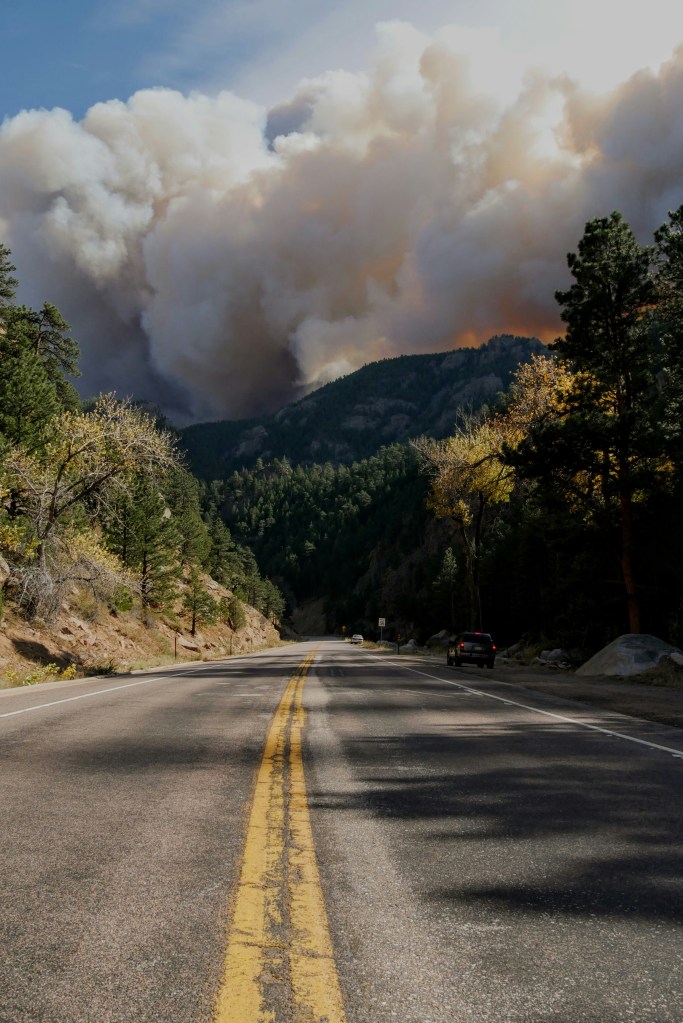
It’s peak wildfire season in Wyoming, and with it come health risks from smoke. At school, these risks come when students and staff are outdoors for recess and activities, and indoors, when smoke enters through windows, open doors, and ventilation systems. Wildfire smoke can cause symptoms like runny nose, coughing, and burning eyes. But for some, smoke exposure can be life threatening.
We know smoke is bad for our health because of the substances it contains, but the tiny size of some wildfire smoke particles can actually do the most damage. Particles called PM2.5 are so small (2.5 micrometers), that they can’t be seen with the naked eye. In fact, if you imagine the width of one strand of hair as the width of a pencil, these particles would be smaller than the period at the end of this sentence by comparison. These super-small particles can get deep into lungs, causing lung damage, and even pass into the bloodstream, affecting the heart. Kids age 18 and younger, people older than 65, pregnant people, and those with pre-existing health conditions (including asthma, heart disease, and diabetes) are most at risk.
To protect students and school staff indoors during smoke events
1. Keep windows closed
2. Keep doors closed whenever possible
3. As much as possible, avoid activities the create indoor air pollution and/or release small particles. These include vacuuming, using air fresheners and other scented products, using aerosols, using printers and copiers, and cooking.
4. Consider using portable air cleaners in the building. If you do, make sure these are the kind that filter air with a high-efficiency filter, such as a HEPA filter. Do not use electronic air cleaners that use terms like ionizer, electrostatic precipitator, plasma, photocatalytic oxidation, hydroxyl generator, or UV light. These can produce ozone, which is a dangerous air pollutant. Also, air cleaners are designed to clean different size rooms, so make it’s the right size for the room where it will be used.
5. School facilities staff should check that the school’s HVAC system is using a high efficiency filter, like MERV 13 or higher, if the system can handle it. Enough air flow should be maintained to protect the health of occupants and keep the equipment working properly.
6. For more information, check out “Wildfires and Indoor Air Quality in Schools and Commercial Buildings,” https://www.epa.gov/emergencies-iaq/wildfires-and-indoor-air-quality-schools-and-commercial-buildings
To protect students and school staff outdoors during smoke events
1. Limit activities outdoors based on the amount of smoke in the air, doing less intense activities (for example, walking instead of running) and for shorter amounts of time. More smoke enters the lungs when people breathe harder.
2. Visit www.airnow.gov to see the current air quality conditions for your area. Then look at the “Air Quality and Outdoor Activity Guidance for Schools,” https://document.airnow.gov/air-quality-and-outdoor-guidance-for-schools.pdf , to help make decisions about how much to limit outdoor activities to protect health for those conditions. Another great resource is the “Children and Youth Activities Guide for Air Quality” developed by Washington state, https://doh.wa.gov/sites/default/files/legacy/Documents/Pubs/334-332.pdf
3. When air quality is very poor, outdoor activities should be moved to indoor spaces or be canceled.
4. Make sure students are still given time to be physically active, even if they have to be inside. This could include running and jumping games in the gym if it’s available or dancing, yoga, and games of charades in the classroom.
5. Consider joining the Air Quality Flag Program, https://www.airnow.gov/air-quality-flag-program/ , which creates public awareness of outdoor air quality conditions. It helps people continue to get plenty of physical activity, while still protecting their health from poor air quality.
 Wyoming Healthy Schools