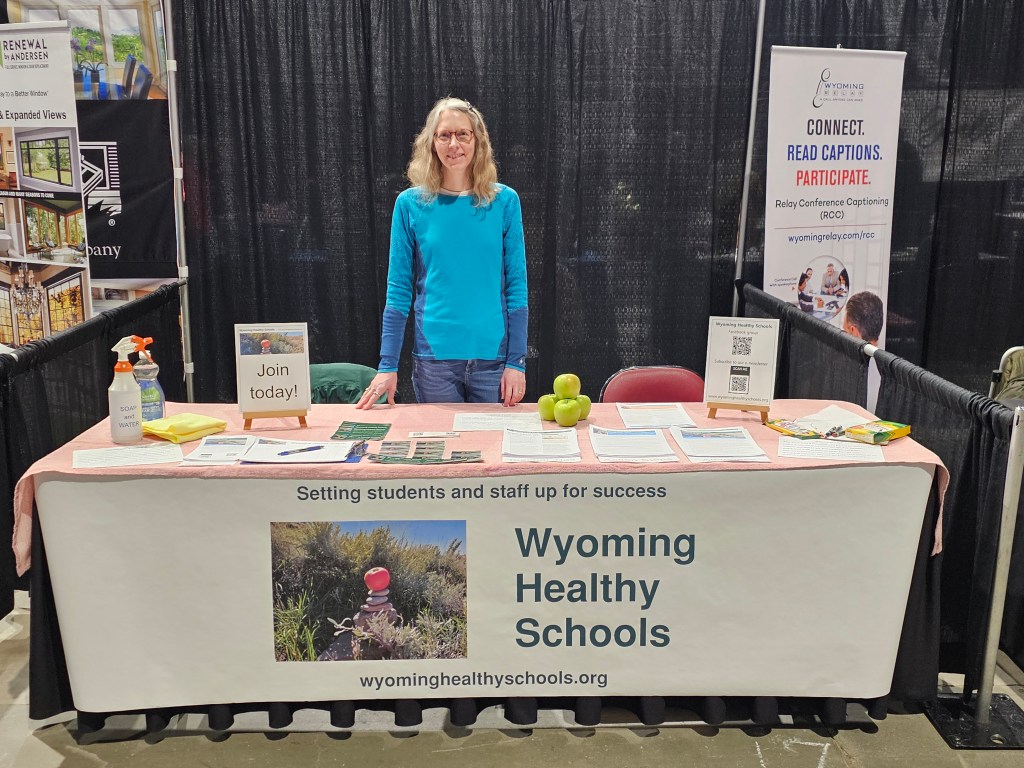
It was great to see some of you at the Wyoming Health Fairs Health & Wellness Expo Health last month, and thank you to our new members for joining! I hope you’ll scroll down to this issue’s Diving Deeper feature: Reaching out to our communities. It includes 8 tips for advocating for healthy schools. If you have problems with any links, try pasting them into your internet browser. If they still don’t work, please let me know. Thanks for your ongoing support of healthier schools. You make a real difference!
Events, Opportunities, & Resources
Upcoming Event: Free webinar-Leveraging Vendor Partnerships to Achieve Efficient Operations, Enhanced Learning, and Healthy, Green Schools; 2/27/25, 12:00-1:00 p.m. MST. For more information and to register, visit https://us06web.zoom.us/webinar/register/WN_njqRSxHYQkGhRxxF82Bz8A#/registration
Opportunity: 2025 Radon Poster Contest for Wyoming students in grades 3-9. Deadline 4/18/25. For rules and submission information, visit https://health.wyo.gov/publichealth/cancer-and-chronic-disease-prevention-unit/cancer/radonpostercontest/
Resource: January was National Radon Awareness Month. For information about radon in Wyoming and how to protect students and staff from radon in schools, check out https://health.wyo.gov/publichealth/cancer-and-chronic-disease-prevention-unit/cancer/radon/ and https://www.epa.gov/radon/radon-schools
Diving Deeper: Reaching out to our communities
Last month I was fortunate to represent Wyoming Healthy Schools at the Wyoming Health Fairs Health & Wellness Expo in Casper. At our table I spoke to dozens of people who stopped to voice their support of healthier schools, pick up information, and/or express concern over what they see in our schools. Among them were parents, grandparents, school employees, and community members. It was a great reminder that health in our schools is a responsibility we all share and impacts whole communities.
So, if you see something a school is doing well to support health, please tell them you appreciate their efforts. Likewise, if you see or hear of something concerning, use your voice to encourage change. Here are 8 tips to help you get started:
· Be prepared. If your concern isn’t an emergency, learn more about the issue before addressing it with others. For example, if your concern is about air fresheners at school that give you or students headaches, you can learn air fresheners and other scented products often contain toxins that are harmful to everyone. If your concern is about students using disinfecting wipes at school, you can learn it’s against federal law for children to use disinfectants, and all disinfectants are regulated as pesticides by the U.S. Environmental Protection Agency. Check out the resources at http://www.wyominghealthyschools.org to get started. If your concern is about a chemical product, you can also do an internet search for the product’s Safety Data Sheet and read product information from its manufacturer to learn more.
· Be respectful. People listen best when they don’t feel attacked.
· Be constructive. When you raise a concern, also suggest a solution if you can. For example, in the case of students using disinfecting wipes, you can suggest trained staff disinfect after school hours when needed. If students need to clean their desks during the day, they can use plain soap and water.
· Be an educator. Consider sharing some of the facts you’ve learned. People are more likely to take action and follow healthy school policies when they understand why it matters.
· Be connected. Consider gathering support from others, such as parents, students, teachers, other school staff, community members, agencies, and organizations like this one. Administrators and school boards may take action faster if they know your concern is shared by a group.
· Be brave. When you speak up for healthier schools, you help everyone who visits, works, and learns in schools. The students and families are worth it. The staff is worth it. You are worth it.
· Be understanding. Most people who work in school systems have the same overall goal: to help kids learn. They might not know the same information you do, though. Working together and learning from each other can lead to the best solutions.
· Be resilient. Advocacy can be a marathon, not a sprint. Big changes take time. Keep trying!
 Wyoming Healthy Schools